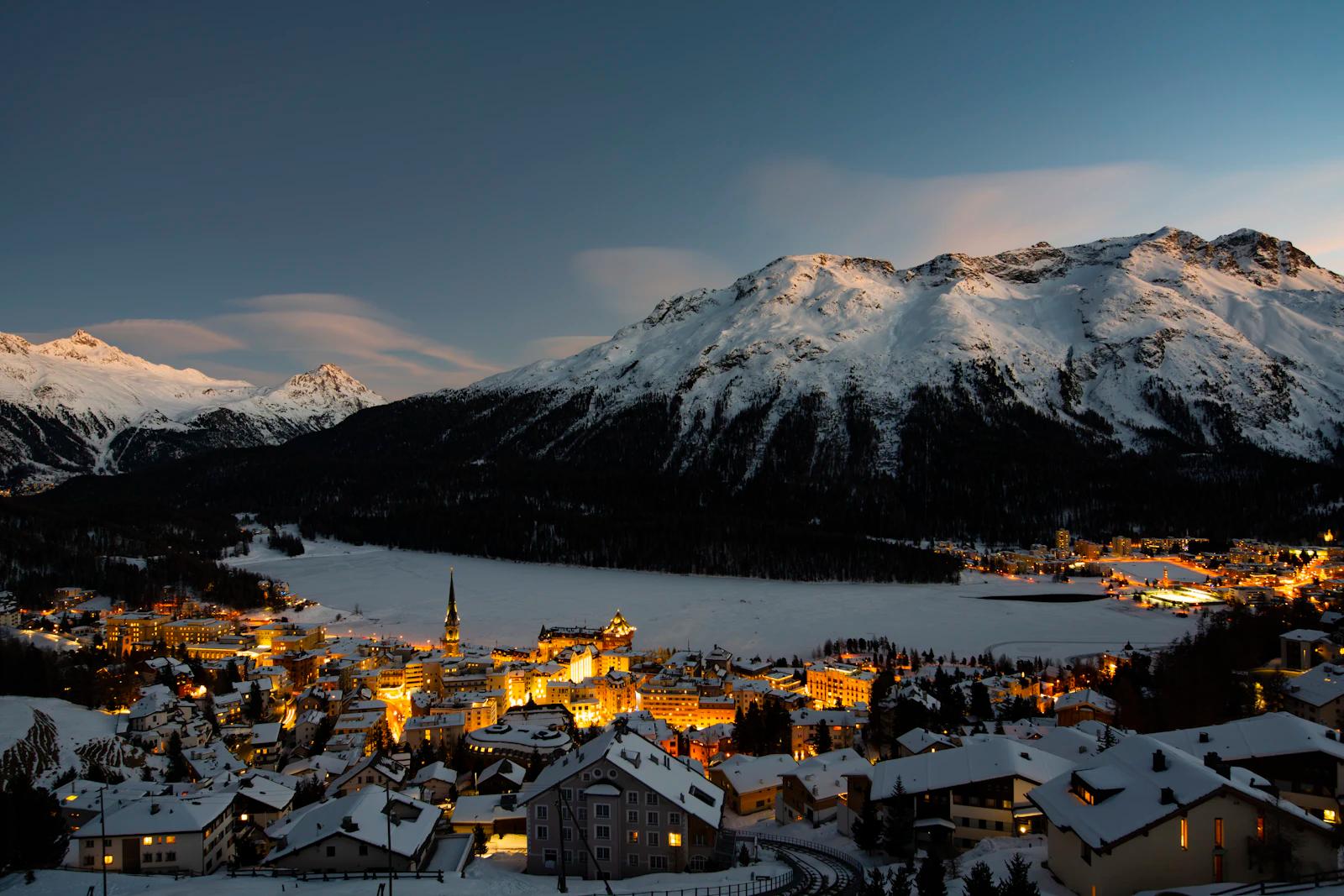
St. Moritz sits at around 1,800 metres in the Upper Engadine, and every road in climbs over an Alpine pass or goes through a mountain on a train. That's part of the appeal. From Milan you follow Lake Como and the Bregaglia valley up the Maloja pass. From Zurich you take the motorway to Chur and cross the Julier, or put the car on the Vereina train. This guide covers each route, the Swiss border with a car hired in Italy, the vignette, winter driving and the big events on the frozen lake.
- From Milan: about 170 km and roughly 3 hours via Lake Como, Chiavenna and the Maloja pass (open all year)
- From Zurich: about 200 km and roughly 3 hours via Chur and the Julier pass (open all year), or the Vereina car train
- Swiss vignette: needed on Swiss motorways (Zurich route), not on the Maloja or Bernina roads
- Winter: Italian approach roads require winter tyres or chains on board from mid-November; in Switzerland, watch for "chains compulsory" signs
- Private flights: Engadin Airport in Samedan, Europe's highest-altitude airport (1,707 m), a few kilometres from St. Moritz
Information checked in October 2026. Rules, timetables and event dates change, so always check the official websites before you travel.
From Milan: Lake Como, Chiavenna and the Maloja pass
This is the classic way up from Italy, and the most beautiful. Journey times and distances below come from the official Engadin tourism site: around 170 km and three hours from Milan. Allow more on winter Saturdays, when half of Lombardy is heading for the mountains.
Milan to Chiavenna
From Milan, and from Linate airport on the east side of the city, take the SS36 north to Lecco. Beyond Lecco it becomes the fast road along the eastern shore of Lake Como, running largely through tunnels to Colico at the top of the lake, then continues up the valley to Chiavenna. From Malpensa, north-west of Milan, use the motorways around the city to join the same road. If you have time and the weather is fine, the western shore through Cernobbio and Menaggio is slower but far prettier.
Arriving at Bergamo Orio al Serio? You are well placed: Lecco and the SS36 are close by.
Chiavenna to the border at Castasegna
From Chiavenna, the SS37 "del Maloja" runs about ten kilometres up to the Swiss border at Castasegna. On the other side you are in the Val Bregaglia, a narrow valley of stone villages and chestnut woods.
The Maloja pass
The Bregaglia road climbs gradually, then finishes with a dramatic series of hairpins up to the Maloja pass (1,815 m). At the top there is no descent: the road levels out straight onto the Engadine plateau, past the lakes of Sils and Silvaplana, to St. Moritz. According to the canton of Graubünden's roads office, the Maloja is one of the passes kept open all year, but heavy snowfall can still cause short closures. The hairpins are tight, so take them slowly in a large SUV and leave room for buses and lorries coming down.
The alternative from Italy: Tirano and the Bernina pass
The other route from Lombardy follows the SS36 to the top of Lake Como, then the SS38 through the Valtellina, past Morbegno and Sondrio, to Tirano. The border is just beyond, at Campocologno. From there the road climbs through the Val Poschiavo and over the Bernina pass (2,328 m), then descends past Pontresina to St. Moritz.
The Bernina is also kept open all year by the canton, and it is a spectacular drive above the glaciers, alongside the famous Bernina railway. It is higher and more exposed than the Maloja, though, so in heavy snow or high winds the Maloja is usually the safer choice. It suits drivers coming from Bergamo, the Valtellina or the eastern side of Lombardy, or anyone who wants to make a loop: up by one pass, back by the other.
Crossing into Switzerland with a car hired in Italy
Switzerland is in the Schengen area but not in the EU customs union, so the border at Castasegna or Campocologno is a real customs post, even if you are usually waved through.
If you live outside Switzerland
According to the Swiss Federal Office for Customs and Border Security (FOCBS), people resident abroad may enter and leave Switzerland informally with a foreign-registered vehicle for private use, such as a holiday. The car must be properly registered abroad, and the necessary road taxes, in practice the vignette, must be paid.
If you live in Switzerland
The rules are stricter. A Swiss resident who rents a car abroad for private use must ask Swiss customs for a temporary certificate (form 15.25) on entry, at a manned border crossing during opening hours. It is valid for eight days from the start of the rental contract, and the rental agreement must be available for inspection at all times. If that applies to you, tell us when you book so the handover can be planned around it.
Documents to carry
- Passport or national ID card for everyone in the car
- Your driving licence (if it was issued outside the EU, check whether you need an international driving permit)
- The vehicle registration document and the rental agreement, both handed over with the car
Customs allowances on goods also apply. If you are bringing wine or food for the chalet, check the FOCBS guidance for travellers.
From Zurich: Chur and the Julier pass
From Zurich (city or airport), take the A3 along Lake Zurich and the Walensee to Sargans, then the A13 south to Chur. The motorway ends there. Follow signs for Lenzerheide, then drop down to Tiefencastel and climb through Savognin and Bivio to the Julier pass (2,284 m). From the summit, the road descends to Silvaplana, a few minutes from St. Moritz. Count on about 200 km and three hours.
The Julier is one of the canton's all-year passes and is the main road link from Chur to the Upper Engadine. It is wide and well built, but at over 2,000 metres conditions can change in minutes.
The Vereina car train: Klosters to Sagliains
If the forecast is bad, or you are coming from the north-east (Landquart, Davos, Klosters), the Vereina car transporter operated by the Rhaetian Railway (RhB) skips the pass altogether. You drive onto the train at Klosters Selfranga and stay in the car for the 18-minute ride through the 19 km Vereina tunnel to Sagliains in the Lower Engadine, then drive up the valley via Zernez to St. Moritz.
- It runs all year, with departures every half hour during operating hours
- Reservations are not possible: you buy a ticket at the station or, for some vehicle categories, online
- The last trains leave in the evening, so check the timetable if you are arriving late
The nearby Flüela and Albula passes are closed in winter, so in the cold season the choice from the north is the Julier or the Vereina.
The Swiss motorway vignette
Switzerland's motorways and expressways require a vignette. According to the FOCBS, it costs CHF 40 at the time of writing and is valid from 1 December of the previous year to 31 January of the following year. It exists as a windscreen sticker or as an e-vignette linked to the number plate.
- Zurich route: the A3 and A13 are motorways, so the vignette is required.
- Maloja or Bernina from Italy: these are main roads rather than motorways, so the vignette is not required as long as you stay off Swiss motorways.
- Buying it: the official shop is via.admin.ch. FOCBS warns that third-party websites add surcharges, so use the official shop. With foreign plates, enter the number carefully: a correction is possible only once, within 24 hours of purchase.
Ask at booking whether your car already has a valid vignette for the dates of your trip.
Winter conditions, tyres and chains
On the Italian side
ANAS, which manages the state roads, issues an ordinance each winter for Lombardy requiring winter tyres or chains on board on its roads, including the SS36 to Chiavenna, the SS37 to the border and the SS38 through the Valtellina. It starts on 15 November and runs into the spring (the exact end date is set each season), and it also applies outside those dates whenever there is snow or ice. The current ordinance is published on stradeanas.it.
On the Swiss side
Switzerland has no general winter-tyre law, but drivers must keep their vehicle fit for the conditions. On certain stretches, a round blue "chains compulsory" sign makes snow chains mandatory. Check pass status before you leave on the TCS pass portal.
In practice
- Every IsyLuxe car has winter tyres in the cold season, so the Italian ordinance is covered.
- If heavy snow is forecast, carry chains that fit the car's tyre size and know how to fit them before you need them.
- Allow extra time: snow ploughs, buses and slow traffic on the hairpins add up.
- Fill up in the valley and keep the screenwash topped up with winter fluid.
- In St. Moritz itself, hotels and chalets often have steep, icy driveways; take them slowly.
Arriving by private jet: Engadin Airport, Samedan
Engadin Airport St. Moritz – Samedan sits at 1,707 m, which makes it Europe's highest-altitude airport. It handles business jets, helicopters and private aircraft, and it gets very busy on the big event weekends. It is a few kilometres down the valley from St. Moritz, so the car can be waiting at the airport when you land. Handover can be arranged there, at your hotel or at your chalet.
Events: White Turf and the Snow Polo World Cup 2027
Two winter events bring St. Moritz's frozen lake to life, and both draw a large crowd of visitors arriving by car and private jet:
- Snow Polo World Cup St. Moritz: the 42nd edition takes place on 22–24 January 2027, according to the official tournament site. It is the world's only high-goal polo tournament on snow, held here since 1985.
- White Turf: international horse racing on the frozen lake since 1907. The 120th edition has race days on 7, 14 and 21 February 2027, according to whiteturf.ch, including the skikjöring, where riders on skis are pulled by galloping horses.
On those weekends hotels fill up, parking in the village is scarce and the passes are busier. Book the car early and arrange the handover at your hotel.
Which car for St. Moritz?
In winter, all-wheel drive and ground clearance matter more than anything else. A Range Rover or Bentley Bentayga is ideal for the Maloja hairpins and long motorway runs from Zurich. The Mercedes-AMG G 63 and Lamborghini Urus are the cars you will see outside the Palace, and the Ferrari Purosangue offers a four-door Ferrari with all-wheel drive. For families or groups with ski bags, the Land Rover Defender 130 or Mercedes V-Class 4MATIC (up to 8 seats) and the 7-seat BMW X7 make sense. An Audi RS6 Avant combines a big boot with sports-car pace.
In summer the passes are pure driving pleasure: a Porsche 911, a Ferrari Roma Spider or a Mercedes SL 63 with the roof down over the Maloja and Bernina is hard to beat.
You book the exact model, never "or similar", with insurance and 24/7 assistance included. Delivery can be arranged at an airport, a station, a hotel or a chalet. See our pages for luxury car rental in St. Moritz, Milan, Zurich and Bergamo.
Frequently asked questions
Is the Maloja pass open in winter?
Yes. The canton of Graubünden keeps the Maloja open all year, as it does the Julier and the Bernina. Heavy snowfall can cause temporary closures, so check conditions before you leave.
Do I need a Swiss vignette to drive from Milan to St. Moritz?
Not if you only take the Maloja or Bernina route, which don't use Swiss motorways. If you also drive to Zurich or anywhere else on Swiss motorways, you need one.
Can I take a car hired in Italy into Switzerland?
Yes. If you live outside Switzerland, you can enter informally for private use with the car's registration document and rental agreement. Swiss residents need a temporary certificate (form 15.25) from customs at the border.
Which is faster from Zurich, the Julier or the Vereina train?
Through Chur and the Julier is the direct route to St. Moritz. The Vereina makes sense in bad weather, or if you are coming from Klosters, Davos or the Prättigau. You can't book it, so allow for queues at busy times.
Can I land at Samedan and have the car waiting?
Yes. Handover at Engadin Airport, or at your hotel or chalet, can be arranged when you book.
Related guides: Driving to the Alps in winter: the rules country by country.