Few drives in Europe are as rewarding as a Tuscany road trip: vineyards along the Chiantigiana, the bare clay hills of the Crete Senesi, the cypress-lined bends of the Val d'Orcia and, if you have an extra day, the Etruscan Coast or Versilia. This itinerary starts in Florence and takes three to five days. It covers the route, the viewpoints worth the detour, the rules that catch visitors out (ZTLs, gravel roads, alcohol limits) and which car suits which kind of trip.
- Start: Florence; the core route takes three days, plus one or two optional extra days
- Day 1: Chianti on the SR222 (Greve, Panzano, Castellina, with a detour to Radda)
- Day 2: Siena and the Crete Senesi
- Day 3: Val d'Orcia (Pienza, Montalcino, San Quirico d'Orcia, Bagno Vignoni)
- Day 4–5 (optional): Bolgheri and the Etruscan Coast, or Lucca and Versilia
- Watch out for: camera-enforced ZTLs in historic centres, unsurfaced strade bianche and Italy's drink-drive limits
Information checked in October 2026. Rules, ordinances and event dates can change, so always check the official websites before you travel.
Day 1: Chianti on the SR222 Chiantigiana
The SR222, known as the Chiantigiana, runs for about 70 km between Florence and Siena through the heart of the Chianti Classico area. Driven without stops it takes under two hours; with tastings, lunch and a few villages it fills a whole day. Leave Florence to the south-east and follow the signs for Greve in Chianti. The official Tuscany tourism site has a good car tour of the Chiantigiana for extra ideas.
Greve in Chianti and Montefioralle
Greve is built around its funnel-shaped Piazza Matteotti, lined with porticoes, wine shops and butchers. Just above it, the tiny walled hamlet of Montefioralle is a ten-minute climb by car and one of the prettiest viewpoints over the valley.
Panzano in Chianti
A few kilometres further south, Panzano overlooks the "Conca d'Oro", a natural amphitheatre of vineyards. It is a classic stop for lunch, and many of the surrounding estates offer tastings by appointment.
Castellina in Chianti and Radda in Chianti
Castellina sits right on the SR222, with a medieval fortress and the covered Via delle Volte running along the old walls. Radda is not on the Chiantigiana itself: take the SR429 east from near Castellina, about 15 minutes of wonderful curves through the woods. From Radda you can rejoin the SR222 and continue to Siena, or spend the night in the hills and arrive the next morning.
Tip: the quickest way back to Florence, or straight to Siena, is the toll-free Florence–Siena dual carriageway, locally called the "Autopalio". Use it for transfers and keep the SR222 for the scenic day.
Day 2: Siena and the Crete Senesi
Siena
Siena's historic centre is a UNESCO World Heritage Site and almost entirely closed to traffic. Do not drive inside the walls: park in one of the car parks outside or at the edge of the centre (Il Campo, Santa Caterina, Stadio-Fortezza and San Francesco are the usual choices, some linked to the centre by escalators) and walk in. Allow at least half a day for Piazza del Campo, the Torre del Mangia, the Duomo and the Santa Maria della Scala complex.
The Crete Senesi along the Lauretana
In the afternoon, head south-east on the SP438 Lauretana between Siena and Asciano, roughly 30 km of open, rolling road across the grey clay hills of the Crete Senesi. It is spectacular at sunset and in spring, when the fields are green; by late summer the landscape turns to gold and ochre. Look out for the serpentine cypress avenue of Baccoleno, near Asciano, one of the most photographed images in Tuscany. Continue south towards the abbey of Monte Oliveto Maggiore, set among cypresses on a ridge, and on to Buonconvento, which puts you within half an hour of the Val d'Orcia for the next day. Tuscany's tourism board describes the Lauretana route in detail.
Day 3: the Val d'Orcia
The Val d'Orcia was inscribed as a UNESCO World Heritage cultural landscape in 2004, and it is the Tuscany of postcards: rounded hills, solitary farmhouses and lines of cypresses. Distances are short, so the day is about stopping, not driving.
Montalcino
Home of Brunello di Montalcino, the hilltop town is crowned by its fortress, with sweeping views over the valley. Many of the estates around it welcome visitors for tastings, usually by appointment, and several are reached on unsurfaced roads (see the practicalities below).
San Quirico d'Orcia and Bagno Vignoni
San Quirico d'Orcia, on the Via Cassia (SR2), has the Collegiata and the Horti Leonini, a Renaissance garden open to the public. A few minutes south, Bagno Vignoni has a sixteenth-century thermal pool instead of a main square. Bathing is not allowed in the historic pool or in the Parco dei Mulini below it; to soak in the hot spring water, book one of the spas in the village.
Pienza
Pienza, rebuilt by Pope Pius II in the 15th century as an "ideal town", is a UNESCO site in its own right. Walk the panoramic lane behind the cathedral for one of the finest views of the valley, and try the local pecorino. If you have time, Montepulciano, home of Vino Nobile, is about 20 minutes further east.
The famous cypress viewpoints
- The cypresses of San Quirico: the perfect circle of trees on a small hill, between San Quirico and Torrenieri off the Cassia. There is a small lay-by nearby; park off the road and walk.
- Cappella della Madonna di Vitaleta: the little chapel framed by cypresses, between San Quirico and Pienza off the SP146. The last stretch is a farm track; leave the car where signed and walk the final part.
- The Monticchiello bends: the zigzag road lined with cypresses below Monticchiello, south-east of Pienza. Most photographers shoot it from the road above at sunrise, when there is often mist in the valley.
These viewpoints sit on working farmland: never block a field entrance or private drive, and do not stop on bends.
Day 4 (optional): Bolgheri and the Etruscan Coast
From the Val d'Orcia it is roughly two and a half hours west to the coast. The highlight is the Viale dei Cipressi: about 4.7 km of cypresses running dead straight from the Oratory of San Guido on the Via Aurelia to the castle gate of Bolgheri, immortalised by Giosuè Carducci in the poem "Davanti San Guido" (details from the Municipality of Castagneto Carducci). Drive it slowly; it is a public road, and cyclists and walkers use it too. Bolgheri is the land of Sassicaia and the "Super Tuscans", and the area has many estates open for tastings.
From there the Etruscan Coast continues south: the hilltop village of Castagneto Carducci, the beaches of San Vincenzo and the Gulf of Baratti, with the Etruscan necropolis of Populonia overlooking the sea.
Alternative day 4–5: Lucca and Versilia
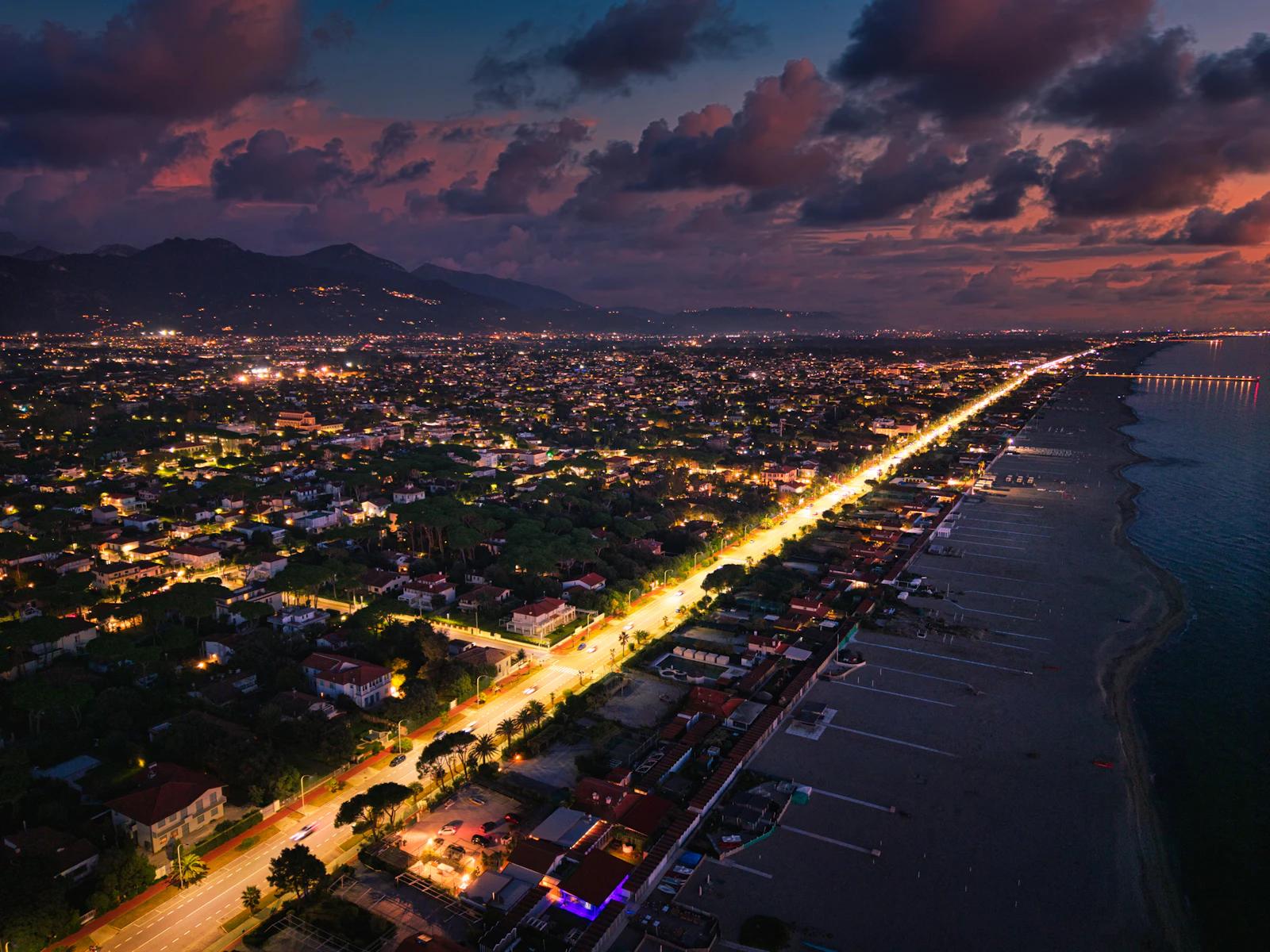
If you prefer the sea north of Pisa, drive to Lucca and walk or cycle its Renaissance walls (cars are not allowed on them, and the centre is a ZTL). From Lucca it is a short run to Versilia: Pietrasanta, with its sculptors' workshops, and Forte dei Marmi, with its pier, beach clubs and boutiques. You can find cars in the area on our luxury car rental in Forte dei Marmi page. Versilia is around an hour and a quarter from Florence by motorway, so it also works as the last stop before heading home.
Practicalities
ZTLs: park outside the walls
Almost every historic centre on this route, from Florence and Siena to Pienza, Montalcino and Lucca, has a ZTL (zona a traffico limitato). Entry points are watched by cameras that read number plates, and fines are sent to the car's owner, which means they reach you through the rental company weeks later. In Florence the ZTL in the central sectors applies Monday to Friday from 7.30 to 20.00 and on Saturday from 7.30 to 16.00, with extra night-time hours on Thursday, Friday and Saturday in the warmer months (see the City of Florence mobility site). If your hotel is inside a ZTL, ask it before arrival whether it can register your plate for access; never assume a booking gives you permission. In the villages, the simplest rule is to use the signed car park outside the walls and walk.
Strade bianche: gravel roads and which car suits them
Many wineries, agriturismi and villas are reached on strade bianche, the white gravel roads of the Tuscan countryside. They are usually well maintained but dusty in summer, rutted after rain and sometimes steep. At low speed any car will cope, but a low supercar risks scraping its underbody and collecting stone chips. If your hotel or the estates on your list are down a gravel track, an SUV with good ground clearance is the relaxed choice; check the last kilometres on the map before you book.
Wine tasting: never drink and drive
Tuscany is a wine trip, so plan for it. In Italy the general blood-alcohol limit is 0.5 g/l, and it is zero for drivers in their first three years with a category B licence, drivers under 21 and professional drivers (article 186-bis of the Highway Code). Penalties are severe and roadside checks are common in wine areas. The best approach is simple: the driver does not drink. Use the spittoon at tastings, buy bottles to open in the evening, or book a tasting at the estate where you are staying.
Speed limits and other rules
- Motorways: 130 km/h, 110 km/h in rain or snow.
- Main roads outside towns: 110 km/h; other roads outside towns: 90 km/h; towns: 50 km/h, unless signed otherwise.
- New drivers (licence held for less than three years): 100 km/h on motorways and 90 km/h on main roads outside towns.
Limits are set by article 142 of the Highway Code, and many roads in the Chianti and the Val d'Orcia have lower signed limits and average-speed or fixed cameras.
Best seasons
- April to June: green hills, wild flowers and mild temperatures; the ideal time for a convertible.
- July and August: hot and busy, with the hills turned gold once the wheat has been cut. Drive early and late, rest in the middle of the day.
- September and October: the grape harvest, the vendemmia, usually runs from September into October. The light is beautiful and estates are busy, so book visits in advance.
- November to March: quiet roads and truffle season, but short days. Winter-equipment ordinances apply on many Tuscan main roads, including the Florence–Siena dual carriageway, in the cold season; every IsyLuxe car has winter tyres in the cold season.
The Palio di Siena
The Palio is run in Piazza del Campo every year on 2 July and 16 August, with trial races and events in the days before. It is an extraordinary spectacle, but the city is packed and traffic and parking are very difficult. If you are not going for the Palio, plan Siena on a different day; if you are, arrive early, park well outside the centre and book accommodation long in advance.
Which car for a Tuscany road trip?
On the SR222 in spring, summer and early autumn, a convertible is hard to beat: a Porsche 911 cabriolet, a Ferrari Roma Spider or Portofino, or a Mercedes SL 63 turns the Chiantigiana into the drive of the trip. Remember that the boot is small, so travel light.
If your villa or the estates on your list are on gravel roads, or you are carrying luggage and cases of wine, an SUV is the better tool: a Range Rover, Bentley Bentayga, Porsche Cayenne or Land Rover Defender has the ground clearance and the space, while a Lamborghini Urus or Ferrari Purosangue keeps the performance. An Audi RS6 Avant is a fine middle ground for asphalt and luggage. For groups and families, the Mercedes V-Class 4MATIC or a Defender 130 take up to eight people, and a BMW X7 seats seven.
Whichever you choose, you book the exact model, with insurance and 24/7 assistance included, and handover can be arranged at the airport, the station, your hotel or your villa. See our luxury car rental in Florence page to start the trip, and if you are combining Tuscany with the capital, our luxury car rental in Rome page: the Val d'Orcia is around two and a half hours from Rome along the A1.
Frequently asked questions
How many days do I need for a Tuscany road trip?
Three days cover Chianti, Siena and the Val d'Orcia at a relaxed pace. Add a fourth day for Bolgheri and the coast, or for Lucca and Versilia, and a fifth if you want time for long lunches and tastings.
Is the SR222 the same as the Chiantigiana?
Yes. The SR222 Chiantigiana links Florence and Siena through Greve, Panzano and Castellina. Radda and Gaiole are a short detour off it.
Can I drive into Florence or Siena?
Not into the historic centres without permission: both are ZTLs enforced by cameras. Park outside and walk in, or ask your hotel whether it can register your plate.
Can I drink at wine tastings if I am driving?
The limit is 0.5 g/l for most drivers and zero for new drivers, drivers under 21 and professionals. The safe rule is that the driver does not drink at all.
Is a supercar suitable for Tuscany?
On asphalt, absolutely. On gravel roads to estates and farmhouses it is better to choose an SUV, or check the access road before you go.
When is the Palio di Siena?
Every year on 2 July and 16 August, in Piazza del Campo. Expect crowds and traffic restrictions in Siena on those days.