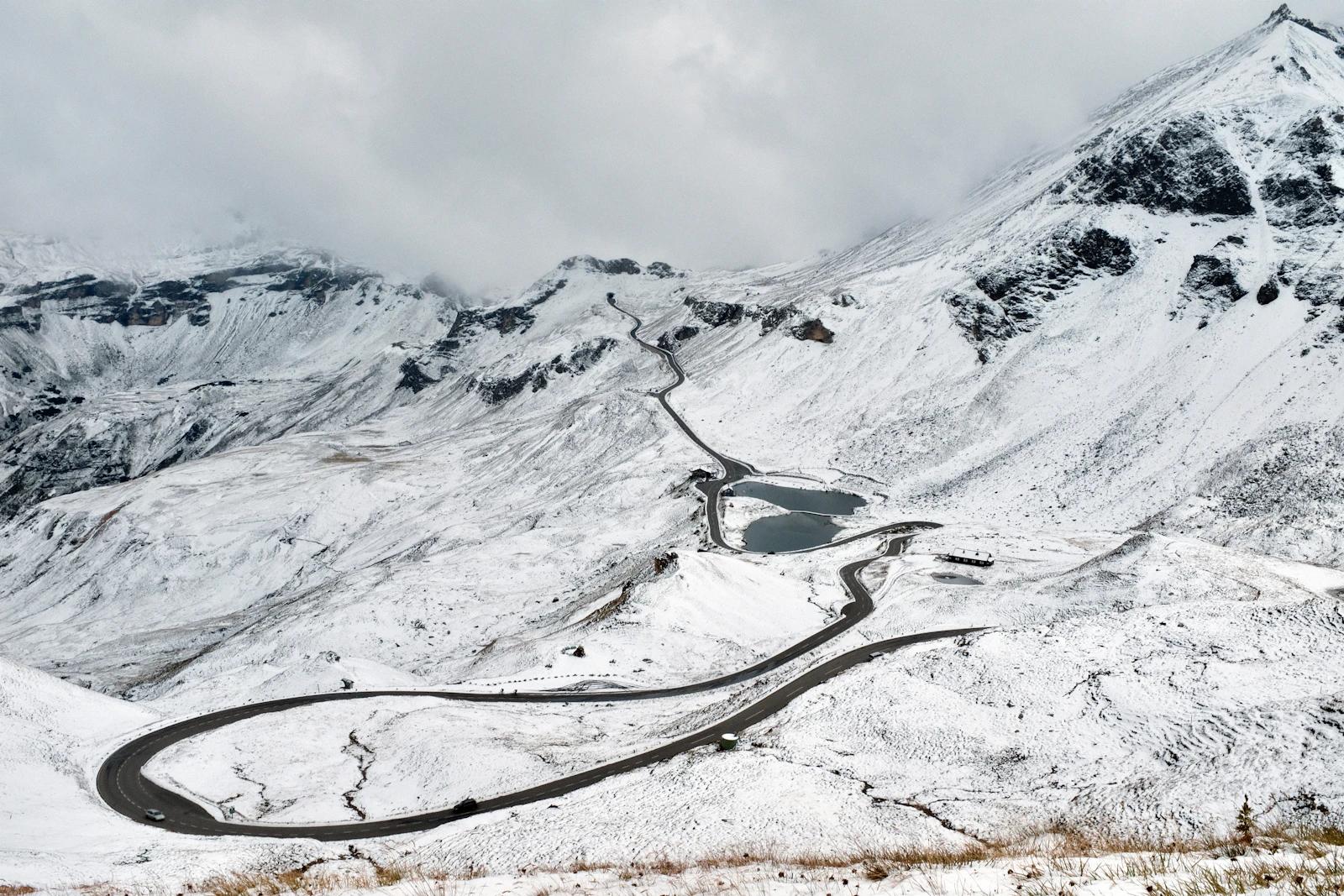
A winter drive into the Alps is one of the great European road trips: frozen lakes, snow-laden larches and a chalet at the end of the road. It also means four countries with four different sets of rules. France, Italy, Switzerland and Austria each handle winter tyres, snow chains, motorway charges and pass closures in their own way, and a rental car often crosses two or three borders on a single trip. This guide sets out the rules country by country, the tunnels and passes that matter, and what to sort out with the rental company before you set off.
- France: winter tyres (3PMSF) or chains/socks on board in designated mountain areas, 1 November to 31 March
- Italy: winter tyres or chains on board, usually 15 November to 15 April where signed; from 15 October on the state roads of the Aosta Valley
- Austria: winter tyres compulsory in wintry conditions, 1 November to 15 April; digital or sticker vignette for motorways
- Switzerland: no general winter tyre law, but chains where signed; CHF 40 motorway vignette (sticker or e-vignette)
- Everywhere: a blue round sign showing a tyre with chains means chains on at least two driven wheels
Information checked in October 2026. Rules, dates and closures change from season to season, so always check the official websites linked below before you travel.
France: the Loi Montagne
Since 2021 the “Loi Montagne” requires vehicles in designated mountain municipalities to be equipped for winter from 1 November to 31 March. The prefects of 34 departments across the Alps, Jura, Massif Central, Pyrenees and Vosges decide which municipalities are covered; in practice, the roads up to the big Savoie and Haute-Savoie resorts are inside the zone. Signs mark where the obligation begins and ends, with a panel reminding you of the winter period.
You must either:
- have four winter tyres (or all-season tyres) carrying the 3PMSF marking, the mountain-with-snowflake symbol; tyres marked only M+S no longer count since 1 November 2024; or
- carry removable snow chains or textile snow socks that fit at least two driven wheels.
The rule applies to every vehicle with four or more wheels, cars, vans and motorhomes alike; cars on studded tyres are exempt. The official summary is on service-public.gouv.fr. Separately, when the chains-required sign is displayed on a climb, it must be obeyed.
French tolls
French motorways are mostly tolled at barriers: take a ticket on entry and pay by card at the exit. There is no vignette. The two big tunnels into Italy, Mont Blanc and Fréjus, charge their own tolls.
Italy: ordinances, not one national date
Italy has no single national winter-tyre law. Instead, each road operator issues an ordinance for the roads it manages, and signs at the start of the stretch show the obligation and its dates. The standard period is 15 November to 15 April: you must have winter tyres fitted or chains on board, and be ready to fit chains if snow or ice demands it. Italy accepts tyres marked M+S as winter tyres, and during the winter period a lower speed index (down to Q) is allowed.
Aosta Valley: from 15 October
On the Aosta Valley's exposed state roads the obligation starts a month earlier, from 15 October to 15 April. According to ANAS, it covers the SS26 from Pont-Saint-Martin to the Little St Bernard pass, the SS26 Dir between Pré-Saint-Didier and the Mont Blanc Tunnel at Courmayeur, and the SS27 up to the Great St Bernard. If you are heading for Courmayeur in late October, this is the date that applies.
South Tyrol (Alto Adige) and the Brenner motorway
On the A22 Brenner motorway, winter tyres fitted or chains on board are compulsory from 15 November to 15 April, even when there is no snow, according to Autostrada del Brennero. The province of Bolzano applies the same fixed rule in the city of Bolzano, while on the other state and provincial roads of South Tyrol, including the high passes towards the Dolomites, winter equipment is required whenever there is snow or ice on the road (Province of Bolzano).
Italian tolls
Italian motorways (autostrade) are tolled at barriers: take a ticket on entry and pay at the exit by card or cash, using the lanes marked for each method. Avoid the yellow Telepass lanes unless the car has a transponder. There is no vignette.
Switzerland: personal responsibility and a vignette
Switzerland has no general legal obligation to fit winter tyres. The law does, however, require you to keep your car under control at all times, and the Touring Club Suisse (TCS) points out that if you are involved in an accident on unsuitable tyres, your liability can be engaged and your insurer may reduce its cover. Where the chains-required sign is displayed, metal chains must be fitted on at least two driven wheels of the same axle, and you may then drive no faster than 50 km/h.
The Swiss motorway vignette
Every car using Swiss motorways (including the Gotthard and San Bernardino road tunnels) needs a vignette. At the time of writing it costs CHF 40 and covers a full calendar year, from 1 December of the previous year to 31 January of the following one. You can buy it as a sticker or as an e-vignette linked to the number plate, valid immediately, through the official Federal Office for Customs and Border Security (FOCBS) portal. Beware of look-alike resale sites: the official price is CHF 40 with no extra fees. A car registered in Switzerland will normally already have one; a car with foreign plates may not, so ask.
Austria: the situational rule and the digital vignette
Austria's rule is situational. From 1 November to 15 April, cars must have winter tyres fitted whenever there are wintry conditions: snow, slush or ice. Austria accepts tyres marked M+S, M.S., M&S or the snowflake symbol, with at least 4 mm of tread on radial tyres. Summer tyres with chains are only an alternative on a road that is completely, or almost completely, covered by snow or ice. Details are on the website of the Austrian Ministry of Mobility. As elsewhere, the chains sign is binding.
Vignette and route tolls
Austrian motorways and expressways need a vignette. It comes as a 1-day, 10-day, 2-month or annual pass; at the time of writing, a 1-day vignette for a car costs €9.60 and a 10-day one €12.80. The digital vignette is linked to the number plate. Bought online, the 1-day and 10-day versions can be valid immediately, while 2-month and annual vignettes bought online as a consumer only start on the 18th day, because of the EU right of withdrawal. 2026 is the last year of the sticker; from 2027 the vignette will be digital only. See ASFINAG.
Several Alpine routes charge a separate route toll on top of (or instead of) the vignette, including the Brenner motorway (A13), the Arlberg road tunnel (S16), the Tauern motorway and the Karawanken tunnel.
Tunnels and passes: what stays open in winter
The rule of thumb: the main road tunnels stay open all year; many of the famous high passes close from autumn to late spring. Sat-navs do not always know which is which, so check your route before you leave.
France–Italy
- Mont Blanc Tunnel (Chamonix–Courmayeur): open all year and tolled. After long closures for vault renovation in the last few autumns, the operator has announced no long closure in 2026, only scheduled night closures, published in advance (ATMB).
- Fréjus Tunnel (Modane–Bardonecchia): open all year and tolled (SFTRF).
- Closed in winter: the Little St Bernard, Mont Cenis, Iseran and Galibier passes.
Switzerland–Italy
- Great St Bernard Tunnel (Martigny–Aosta): open all year, with its own toll (letunnel.com). The pass road above it closes for the winter, usually from mid-October until June.
- Gotthard and San Bernardino: the road tunnels stay open all year on the vignette motorways; the passes over the top close in winter.
Austria–Italy and the Arlberg
- Brenner: the A13/A22 motorway is open all year and is the main winter route between Innsbruck and Bolzano. On the Austrian side, renovation of the Lueg bridge means traffic often runs in a single lane in each direction there, so allow extra time on busy weekends.
- Arlberg road tunnel (S16, St. Anton–Langen): reopened in November 2024 after its last major renovation; ASFINAG says no further long closures are planned for years. It has its own toll.
- Stelvio: closed for the whole winter season.
The Engadine: Julier vs Maloja and Bernina
For St. Moritz, the Julier pass (from Chur), the Maloja pass (from Chiavenna and Lake Como) and the Bernina pass (from Tirano and the Valtellina) are kept open all year, although they can be closed for a few hours in heavy snow and chains may be required. The Albula pass closes for the winter. An alternative to the passes is the Vereina car train from Klosters to Sagliains, near Zernez, which runs all year (Rhaetian Railway). For live status, the TCS pass portal lists every Swiss pass.
Chains-required signs
All four countries use the same core sign: a blue circle showing a tyre wrapped in chains. From that point on, chains must be fitted to at least two driven wheels. In Italy, the ordinance sign at the start of a road usually shows the tyre-with-chains symbol together with the dates of the winter period. In France, separate signs mark the entry and exit of the Loi Montagne zone. A practical point: fit chains before the climb, in a lay-by, not halfway up a hairpin with traffic behind you.
Driving in snow: practical tips
- Check the forecast and road status the evening before and again in the morning: Bison Futé for France, ANAS and Autostrada del Brennero for Italy, ASFINAG for Austria, the TCS for Switzerland.
- Practise fitting chains once, in the hotel car park, before you need them.
- Leave plenty of distance. All-wheel drive helps you get moving, but it does not shorten braking distances.
- Be gentle with throttle, brakes and steering; use a higher gear on slippery climbs, and engine braking on descents.
- Keep the tank at least half full and carry water, warm clothes, gloves and a charged phone in case of a long wait.
- Clear snow from the whole car, roof included, and keep the washer fluid topped up with antifreeze.
- Watch for black ice in shaded sections, on bridges and in the early morning.
- Leave early. Saturday changeover days bring long queues on the access roads to the big resorts.
What to tell the rental company
A few details at the time of booking avoid surprises on the mountain:
- Every country you will drive in, including transits, so cross-border use is covered.
- The resort and the exact address, especially for a chalet up a steep or private road.
- Whether you will need chains or snow socks, and whether they can be fitted to that model; some cars with large wheels and tight wheel arches have restrictions, set out in the owner's manual.
- Vignettes: whether the car already has a valid Swiss or Austrian vignette for its plates, or whether you need to buy one.
- Handover and return times that fit around changeover-day traffic and flight times.
At IsyLuxe, every car runs on winter tyres in the cold season, insurance is included and assistance is available 24/7. You book the exact model, not “or similar”, and the car is delivered where you arrange at booking: the airport, the station, your hotel or your chalet.
Which car for the Alps in winter?
For mountain roads, a four-wheel-drive SUV with good ground clearance is the natural choice. The Range Rover and Bentley Bentayga are the most comfortable for long motorway stretches; the Mercedes-AMG G 63 and Land Rover Defender are made for snowy chalet roads; the Lamborghini Urus, Porsche Cayenne, Audi RS Q8 and Ferrari Purosangue bring performance with all-wheel drive. For families, the BMW X7 and Audi SQ7 seat seven and the Defender 130 up to eight. For a group with skis and luggage, the Mercedes V-Class 4MATIC (up to 8 seats) is the most practical way to arrive together. If you prefer an estate, the Audi RS6 Avant or BMW M3 Touring combine all-wheel drive with a large boot.
Gateway cities and resorts
- Gateways: luxury car rental in Geneva for the French and Swiss Alps, Zurich for Graubünden and the Engadine, Milan for the Aosta Valley, the Dolomites and St. Moritz via the Maloja, and Innsbruck for Tyrol and the Brenner.
- Resorts: Courchevel, St. Moritz, Cortina d'Ampezzo, Madonna di Campiglio and Courmayeur, with delivery to your hotel or chalet.
In summer the same roads open up again, the high passes included, and a Porsche 911 or a Ferrari Roma Spider takes over from the SUV.
Frequently asked questions
Are winter tyres compulsory in the Alps?
It depends on the country. France requires 3PMSF winter tyres or chains on board in mountain areas from 1 November to 31 March; Italy requires winter tyres or chains on board where an ordinance applies, generally 15 November to 15 April (from 15 October in the Aosta Valley); Austria requires winter tyres in wintry conditions from 1 November to 15 April; Switzerland has no general obligation.
Are M+S tyres enough?
In Italy and Austria, M+S tyres count as winter tyres. In France, since 1 November 2024, only tyres with the 3PMSF symbol count; with M+S tyres you must carry chains or socks.
Do I need a vignette in Switzerland and Austria?
Yes, for motorways and expressways. Switzerland's costs CHF 40 for the year at the time of writing; Austria's comes in 1-day, 10-day, 2-month and annual versions. France and Italy use toll barriers instead.
Is the Mont Blanc Tunnel open in winter?
Yes, it is open all year. In 2026 there is no long closure, only scheduled night closures announced in advance by the operator.
Is the Great St Bernard pass open in winter?
No, the pass road closes for the winter; use the Great St Bernard Tunnel, which is open all year.
How do I get to St. Moritz in winter?
Over the Julier pass from Chur, the Maloja pass from Lake Como or the Bernina pass from the Valtellina, all kept open in winter, or by the Vereina car train from Klosters.
Does a four-wheel-drive car need chains?
Yes, when the chains sign says so. Four-wheel drive does not exempt you, and it does not shorten braking distances on snow.
Related guides
- Geneva to Courchevel by car in winter: routes, rules and parking
- Driving to St. Moritz from Milan or Zurich: Passes, Border, Vignette and Winter Tips
- Venice to Cortina d'Ampezzo by Car in Winter: Route, Snow Rules, Passes and Parking
- Geneva to Courmayeur through the Mont Blanc Tunnel: Route, Rules and Closures