Driving in Italy is one of the best ways to see the country: lake roads above Como, the coast road to Positano, Tuscan hills between Florence and Siena. If you are flying in from the US and plan to rent a luxury car in Italy, though, a few things work differently from home. You need more than your state driver's license, historic centers are guarded by cameras, and a fine can reach you months after you fly back. This guide covers it all, from the International Driving Permit to the Amalfi Coast's summer plate rules.
- Documents: valid US driver's license plus an International Driving Permit (IDP), and your passport
- Where to get the IDP: only AAA or AATA, the two issuers authorized by the US Department of State
- Payment: a credit card in the driver's name for the security deposit
- Biggest trap: ZTL limited traffic zones in Florence, Rome, Milan and many smaller towns, enforced by cameras
- Speed: 130 km/h on the autostrada (110 km/h in rain), 50 km/h in towns, with average-speed "Tutor" cameras
- Winter: winter tires or chains on board required on many roads from November 15 to April 15
Information checked in October 2026. Rules, hours and calendars change, so always check the official websites before you travel.
Your license and the International Driving Permit
Italian law (article 135 of the Codice della Strada) lets visitors with a license issued outside the EU drive in Italy, provided they carry, together with the license, an International Driving Permit or an official Italian translation of it. For Americans the IDP is by far the simpler route. It is not a license on its own: it is a booklet that translates your US license, and it is only valid alongside it. Driving without one can lead to a fine if you are stopped by the police, and it can complicate things after an accident, even if nobody asks for it at handover.
Where to get an IDP in the US
According to USA.gov, only two organizations are authorized by the US Department of State to issue IDPs: the American Automobile Association (AAA) and the American Automobile Touring Alliance (AATA). AAA handles applications at its branches, by mail and online; AATA online or by mail. Websites selling an "international driver's license" from anyone else are not official, and the document they sell will not do the job. Apply a few weeks before you travel if you are not going in person, and remember that the IDP is valid only while your US license is.
Age and driving experience
For high-performance cars, rental companies typically ask for a minimum age above the one you may know from mainstream rentals, and a minimum number of years since you passed your test. On IsyLuxe the minimum age and years of license vary from car to car and are shown on each car's page before you book, so check them for the exact model you want. Note too that Italy applies lower speed limits to drivers in their first three years of licensing (100 km/h on the autostrada, 90 km/h on main roads outside towns).
Credit card and security deposit
Every luxury rental comes with a security deposit, held on a card in the driver's name. On cars booked through IsyLuxe it is a pre-authorization (a hold, not a charge), the amount is shown on each car's page and the hold is released immediately or within 48 hours of returning the car. A credit card is the standard method; a debit card in the driver's name or a bank transfer can be arranged on request, while cash and prepaid cards are not accepted. Our guide to the luxury car rental security deposit explains it in detail.
Two tips for US travelers. First, check your credit limit: a hold on a supercar can take a large share of it for the whole trip, so call your card issuer, ask for a temporary increase if needed and tell them you will be using the card in Italy. Second, know your card's PIN: unattended fuel pumps and some toll machines may ask for one.
ZTL: Italy's limited traffic zones
A ZTL (Zona a Traffico Limitato) is an area, usually a historic center, where only authorized vehicles may enter during set hours. Entrances are marked by a round white sign with a red border and the word "ZTL", often with an electronic panel reading varco attivo (gate active, no entry) or varco non attivo (gate not active). Cameras read every number plate. There is no barrier and no warning: if you enter without authorization, a fine is issued automatically, and each separate entry can mean a separate fine. Your GPS will happily route you straight through, so watch the signs, not the screen.
Florence
The whole historic center is a ZTL. According to the City of Florence, the main sectors are active Monday to Friday from 7:30 am to 8 pm and on Saturday from 7:30 am to 4 pm, with an extra night-time ZTL in the warmer months. If your hotel is inside the zone, ask the hotel before you arrive whether it can register your number plate for the drive in; do not assume it is automatic.
Rome
Roma Servizi per la Mobilità lists the Centro Storico daytime ZTL as active from 6:30 am to 6 pm Monday to Friday and from 2 pm to 6 pm on Saturday, plus a night-time ZTL on Friday and Saturday nights (11 pm to 3 am, suspended in August). Trastevere and other districts have their own zones. Plan to leave the car in a garage and explore on foot or by taxi.
Milan: Area C
Milan works differently: Area C, the zone inside the old city walls, is a congestion charge rather than a ban. You can drive in during its daytime hours, but you must buy an entry ticket. According to the official Area C service, the ticket must be activated on the day of entry or by midnight the following day; after that, a late ticket at a higher price is available for a few more days. The city has also announced weekend operation from 2026, so check the current days on the Comune di Milano website. Ask whether your hotel or garage is inside the zone before you set off.
The autostrada: tolls, Telepass and speed
Most Italian motorways are toll roads: you take a ticket on entry and pay on exit. The lanes at the toll booth are color-coded, as Autostrade per l'Italia explains:
- Yellow "Telepass" lanes: reserved for cars with a Telepass device. Do not use them unless your car has one fitted and active.
- Blue "Carte" lanes: card payment only (credit and debit cards and Viacard).
- White lanes with a hand or cash symbol: cash, with an attendant or machine.
US credit cards generally work in the blue lanes; keep some euros in cash as a back-up. If something goes wrong at an unmanned exit, press the help button rather than reversing out of the lane.
Speed limits
- Autostrada: 130 km/h (about 80 mph), 110 km/h when it rains
- Main roads outside towns: 110 km/h, 90 km/h in rain
- Other roads outside towns: 90 km/h
- Towns: 50 km/h, often 30 km/h where signed
Lower limits are signed on many stretches. Remember that a limit in km/h on a car with a large engine passes very quickly.
Tutor average-speed cameras
Many motorway stretches are covered by the Tutor system, which photographs your car at two gantries and calculates your average speed between them. Slowing down for one camera does not help: the whole section counts. The newer Tutor 3.0 units can also detect other offenses. Fixed speed cameras (autovelox) are common on ordinary roads too, and are usually announced by a sign.
Fuel
Most luxury cars run on benzina (gasoline); the diesel pump is labeled gasolio or diesel. Check your car's fuel type at handover and never fill up with the wrong one. Many stations have a servito (attendant-served) pump and a cheaper fai da te (self-service) pump. Away from the autostrada, attendants may be off at lunch and at night, leaving only self-service machines that take cards or cash. Prices are per liter, not per gallon.
Parking: the colors matter
- Blue lines: paid parking. Pay at the machine or with a parking app and display the ticket if required.
- White lines: usually free, but check nearby signs for time limits or a parking disc.
- Yellow lines: reserved (residents, disabled badge holders, loading). Do not park there.
With a high-value car, a staffed garage is almost always the best choice in cities. It is also the easiest way to avoid both ZTLs and street parking.
Driving the Amalfi Coast
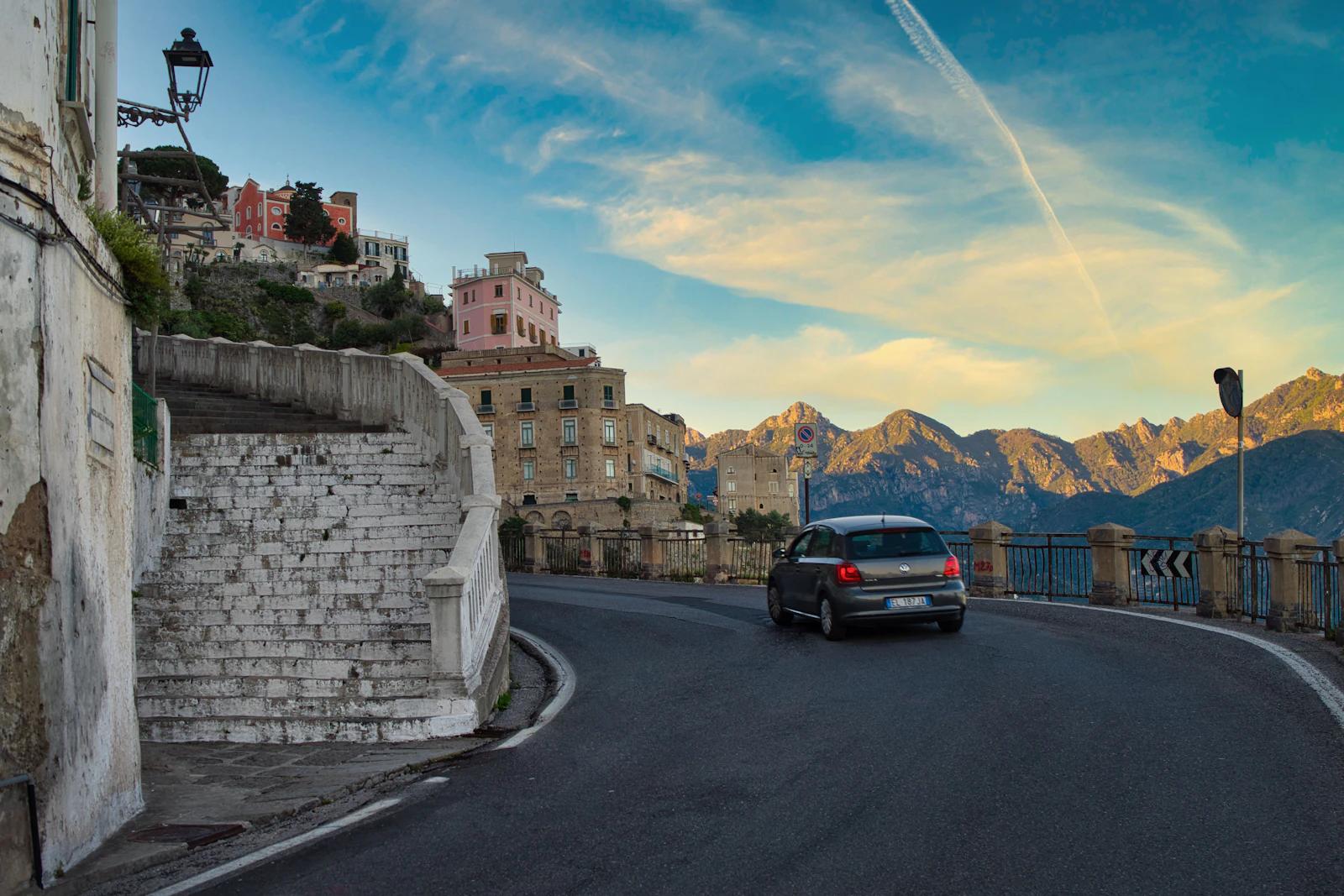
The Amalfitana (state road SS163) is one of the world's great drives and one of its most demanding: narrow, cliff-hugging, full of blind bends, tour buses and scooters. In busy periods it is also subject to alternate-plate rules (targhe alterne) under an Anas ordinance. In 2026 the Town of Amalfi announced restrictions from 10 am to 6 pm over Easter and late April, and they returned for the summer on weekends and holidays and then every day in high season. On odd-numbered dates, cars whose plate ends in an odd number cannot use the road, and on even dates those ending in an even number. Hotel guests with a booking are exempt for arrival and departure only. Check the current calendar before you go, and the last digit of your car's plate.
A more relaxed approach: drive to your hotel, park, and use boats and buses between Positano, Amalfi and Ravello. A compact or mid-size car is far easier here than a wide SUV. Take your time, use your horn on blind bends as locals do, and let faster local drivers pass.
Driving around Lake Como
The roads along Lake Como are beautiful but narrow, especially on the western shore, with tight bends, villages built right up to the road and few places to stop. In summer they are busy, and parking in Bellagio, Varenna or Tremezzo is limited, so ask your villa or hotel about parking before you arrive. The car ferries in the central part of the lake are a pleasant way to cross between shores instead of driving around.
Winter: tires and chains
Between November 15 and April 15, many Italian roads and motorways, especially in the north and in the mountains, require cars to have winter tires or snow chains on board where signs say so, as ACI explains. Exact dates and roads are set by regional and road-operator ordinances. Every car booked through IsyLuxe has winter tires in the cold season, so this is covered for you; heading for the Dolomites or the Alps, still check road conditions before you set off.
Fines after your trip
ZTL, Area C, speed camera and Tutor fines are all recorded by cameras, so nobody stops you at the time. The authority traces the car to its owner, the rental company, which provides the driver's details as set out in the rental agreement. Your rental agreement specifies how fines and any related administrative costs are handled, so read it.
The official notice then reaches you at your US address. For drivers who live abroad, Italian law (article 201 of the Codice della Strada) allows up to 360 days for notification, so a letter can arrive close to a year later. What to do:
- Do not ignore it. Check the date, place and plate against your trip.
- Pay through the channel on the notice, usually a bank transfer or an online portal of the local police (Polizia Locale). Many offenses carry a reduced amount if paid quickly, as stated on the notice.
- Be wary of third parties: pay only the issuing authority or the collection agency named on the official notice.
- If you think it is wrong, the notice explains how to appeal and by when.
Which car, and where
For a road trip with luggage, an SUV such as the Range Rover, the Porsche Cayenne or the Lamborghini Urus covers long autostrada days in comfort; for families or groups, the BMW X7 or the Mercedes V-Class 4MATIC (up to 8 seats). From spring to fall, a Porsche 911 or a Ferrari Roma Spider is made for the lake and coast roads, and the Audi RS6 Avant pairs supercar pace with a wagon's trunk. You book the exact model, never "or similar", and the car can be delivered to the airport, station, hotel or villa, with 24/7 assistance and insurance included.
Start your trip from luxury car rental in Milan, Rome or Florence. For the lakes, see Como; for the south, Naples, Amalfi and Positano. In Venice, cars stop at Piazzale Roma and Tronchetto, so a car is for the trip out: the Dolomites, Lake Garda or the Prosecco hills.
Frequently asked questions
Do Americans need an International Driving Permit to drive in Italy?
Yes. Italian law requires drivers with a non-EU license to carry an International Driving Permit (or an official translation) together with their license. Get the IDP from AAA or AATA before you leave.
Can I get an IDP once I am in Italy?
No. The IDP is issued in the country that issued your license, so get it in the US before you travel.
Can I use my US credit card for the deposit?
Yes, a credit card in the driver's name is the standard method. Check your limit and tell your card issuer about the trip so the hold is not declined.
How do I avoid ZTL fines?
Watch for the round white-and-red ZTL signs, never follow GPS through a "varco attivo" gate, park outside the historic center or in a garage, and ask your hotel in advance if it is inside a zone.
How long after my trip can an Italian fine arrive?
For drivers living abroad, the authorities have up to 360 days from the offense to notify it, so a letter can arrive many months later.
Are the Amalfi Coast alternate-plate rules relevant to rental cars?
The rules apply by number plate on set dates and hours. Hotel guests are exempt for arrival and departure, but for other trips check the calendar and your plate's last digit before you set off.